
Why I Don’t Use a Stop Loss While Trading: My Unorthodox Approach to Trading Risk and Defense

Yusef Scott
Written by Yusef Scott, Founder of SDEFX University™ and Creator of the Trading Framework™
A personal perspective from Yusef Scott on stop-loss orders, active trade management, market liquidity, and the Defensive Trading Playbook™
There is one rule that nearly every new trader hears shortly after entering the financial markets:
Never place a trade without a stop loss.
The statement is repeated in trading courses, books, online communities, broker education centers, and social-media videos. Over time, it has become more than a recommendation. For many traders, it is treated as an unquestionable law.
I understand why.
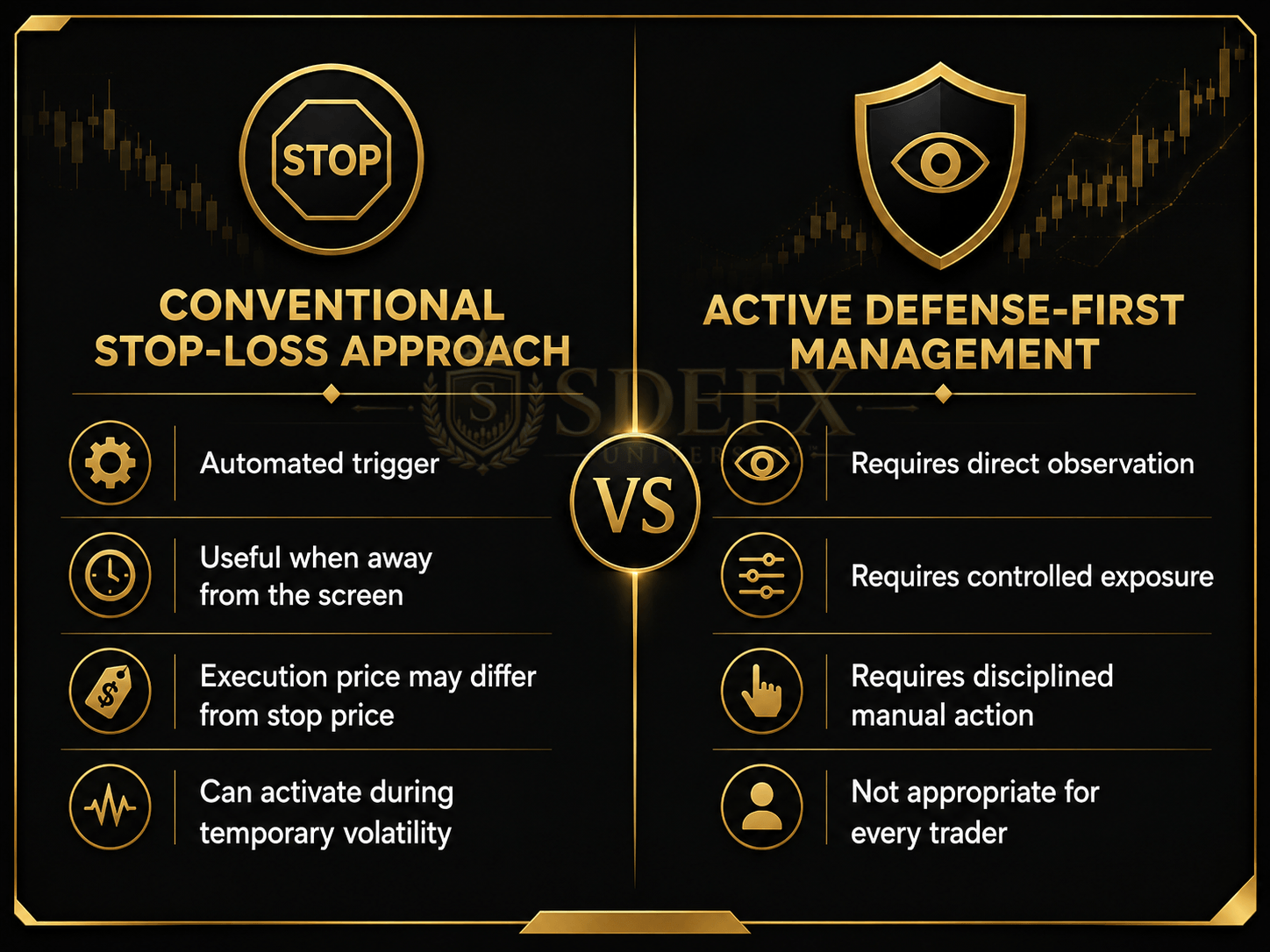
A stop-loss order can establish an automated exit when the market moves against a position. It may help prevent someone from holding a losing trade indefinitely, and it can offer a degree of protection when the trader is unable to monitor the market directly.
The Financial Industry Regulatory Authority explains that investors commonly use stop orders to limit potential losses or protect existing profits. The U.S. Securities and Exchange Commission also provides guidance on how stop, stop-limit, and trailing-stop orders work.
Therefore, let me make my position clear from the beginning:
I am not saying that stop losses have no purpose.
I am not claiming that every trader should remove them. I am not suggesting that trading without one is automatically safer. I am also not advising inexperienced traders to enter leveraged positions without a thoroughly developed risk-management process.
What I am saying is that a conventional stop loss does not fit the way I personally trade.
It also does not fit the approach that many of my students eventually adopt after learning how to trade only what they can directly observe and manage.
I am not your typical trader.
I have always been unorthodox in the way I study the market, question commonly accepted practices, and develop trading processes. I do not follow a rule simply because it was passed down from previous generations of traders and repeated until it became tradition.
I want to know why the rule exists.
I want to understand what it protects.
I also want to examine whether that protection creates an entirely different vulnerability.
That way of thinking became an important part of my Defensive Trading Playbook™, the first component of the Trading Framework™.
The Playbook does not begin by asking how much money a trade might produce.
It begins with a more important question:
How will the trader defend the account before profit becomes the priority?
My decision not to use a conventional stop loss is part of that defense-first philosophy. It is not the absence of risk management. It is an active approach to risk management built around direct observation, preparation, controlled exposure, discipline, and a set of rules that I will not fully disclose within this article.
This article is not intended to teach the proprietary how behind my method.
It is intended to explain why I think differently.
Why Traders Use Stop-Loss Orders
A stop loss offers traders something extremely appealing: the appearance of certainty.
The trader selects an exit price, places the order, and believes the maximum loss has been predetermined.
Psychologically, that can feel reassuring.
It may prevent a trader from freezing while a losing position continues moving against the account. It can also be useful for traders who open positions and then leave their screens.
However, the certainty is not complete.
According to the SEC, once a standard stop price is reached, the stop order generally becomes a market order. The stop price triggers the order, but it does not guarantee the exact execution price. During fast or volatile conditions, the actual fill may be meaningfully different from the level the trader selected.
FINRA issued updated guidance in March 2025 explaining that market volatility can create execution risks around stop and stop-limit orders. A standard stop order may execute away from the expected price, while a stop-limit order provides more price control but may not execute at all. You can review FINRA’s explanation here:
Stop Orders: Factors to Consider During Volatile Markets
This does not mean stop orders are inherently bad.
It means they are not the perfectly controlled insurance policy that many new traders believe them to be.
A trader can control the trigger.
The trader cannot always control the final execution.
That distinction becomes especially important when trading fast-moving instruments such as US30, NAS100, and the S&P 500.
When Your Market Analysis Is Right—but the Trade Still Loses
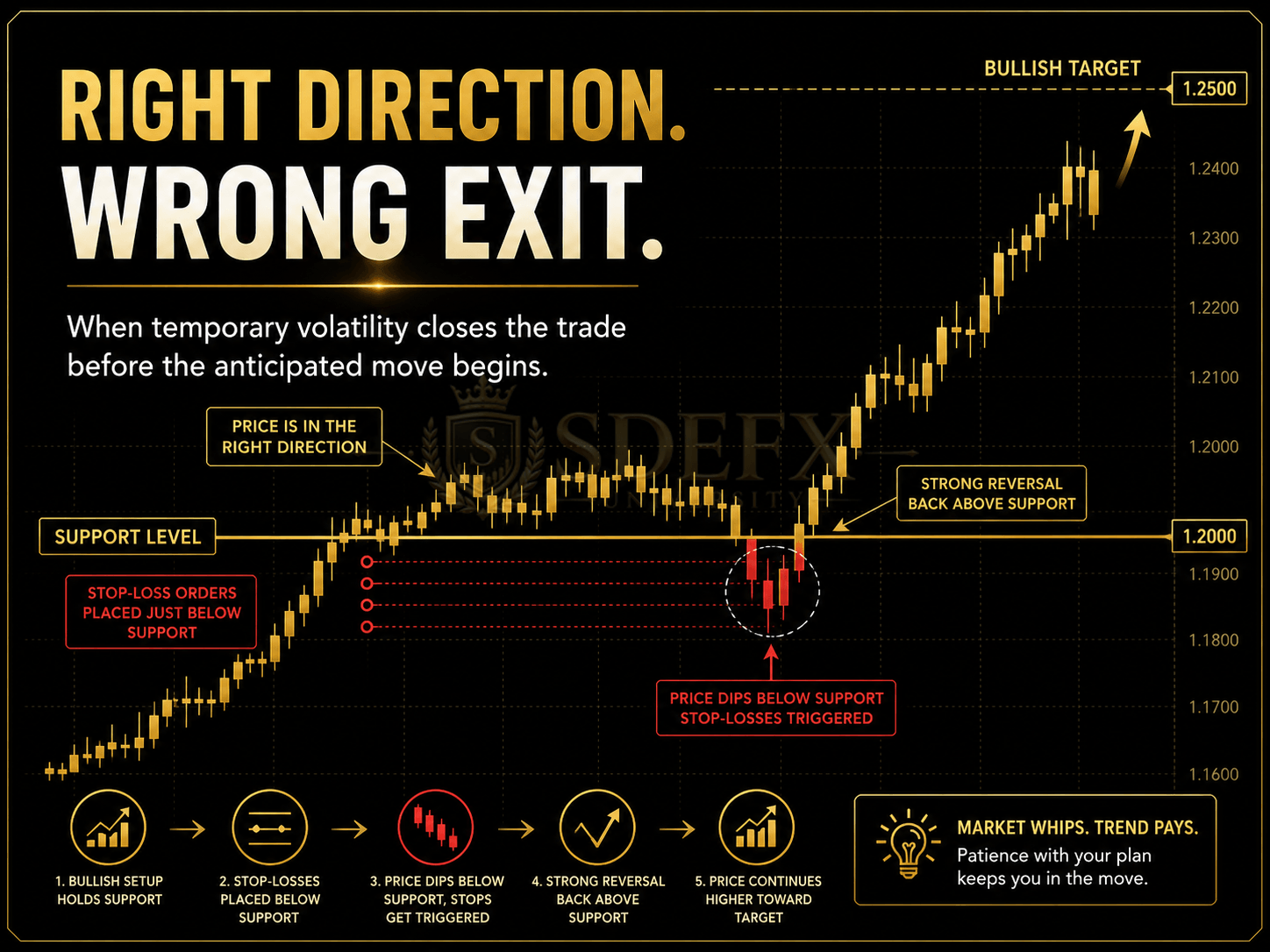
One of the most frustrating experiences in trading occurs when the trader correctly identifies the market’s eventual direction but still loses the trade.
Perhaps you have experienced it.
You study the market and determine that price is likely to move upward.
You enter a buy.
Before moving toward your intended target, price briefly falls, touches your stop loss, closes the position, and then reverses upward.
Your directional analysis was correct.
The market eventually traveled where you expected it to go.
Yet your account recorded a loss.
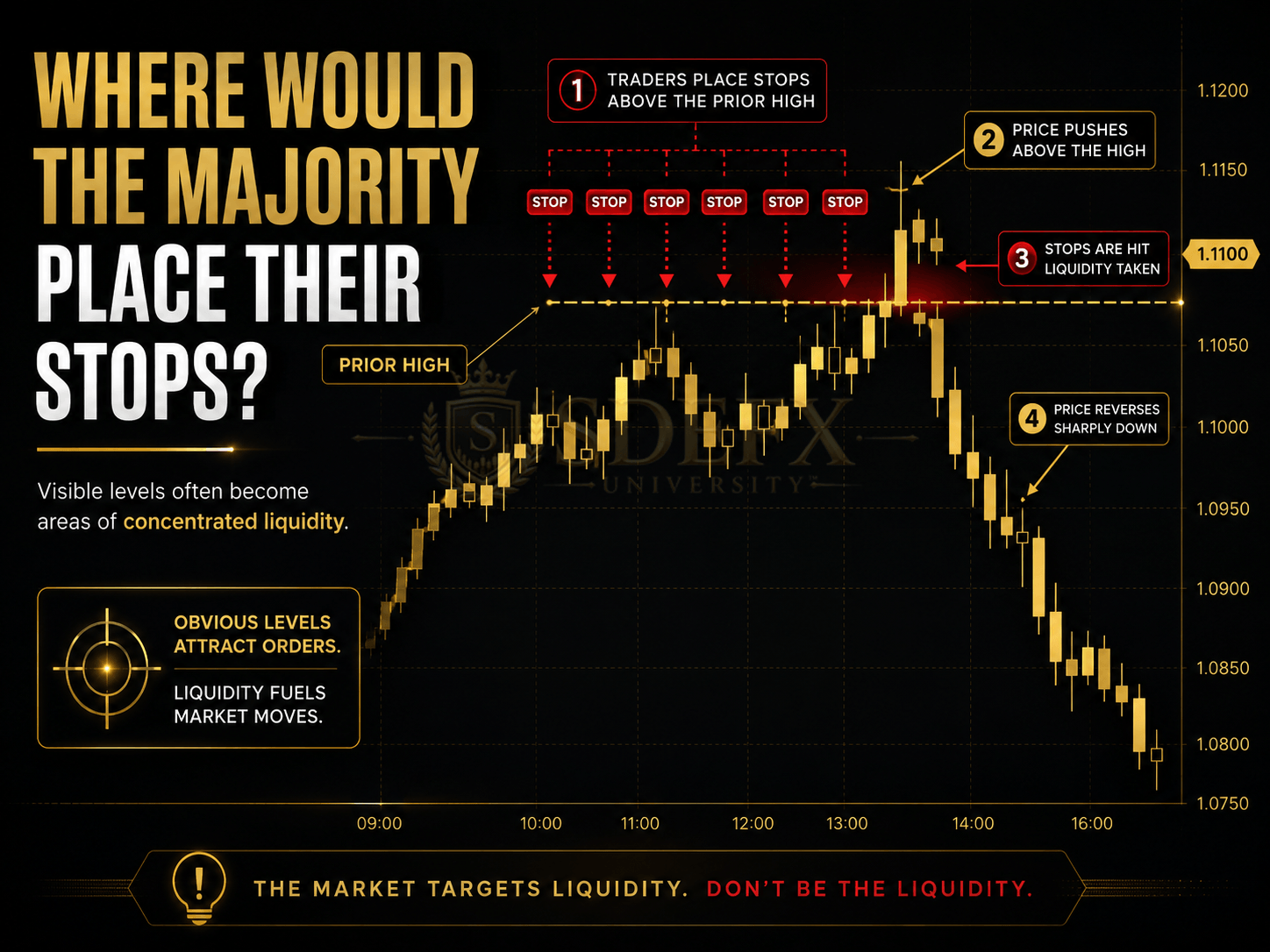
The same can happen to a seller. You may correctly anticipate a downward move, but price briefly rises through a visible high, activates your stop, and then reverses lower.
When this happens repeatedly, traders often begin to question their analytical ability.
They say:
“Maybe I cannot read the market.”
“Perhaps my strategy does not work.”
“Maybe I entered in the wrong direction.”
“I need another indicator.”
“I need a different mentor.”
“I need to change my entire system.”
But the original analysis may not have been the true problem.
The issue may have been the relationship among the entry, the stop-loss placement, normal market movement, current volatility, and the level where orders were likely concentrated.
Markets rarely move in perfectly straight lines.
They expand.
They retrace.
They test prior levels.
They move into areas of liquidity.
They respond to news, volume, positioning, and changing participation.
A correct larger market thesis can survive temporary movement against the position.
The critical question is not simply:
“Did price move against me?”
The better question is:
“Was my analysis truly invalidated, or did the market temporarily move through an obvious area before continuing?”
Those are not the same thing.
Are Stop Hunters Real?
The subject of stop hunting must be discussed carefully.
Some traders imagine that a broker or major institution is personally watching their small individual account and moving an entire global market solely to close their position.
That is generally not a reasonable explanation of how large financial markets operate.
However, the broader market behavior that traders describe as stop hunting is real.
Stop orders frequently cluster around visible and psychologically significant levels, including:
Recent swing highs
Recent swing lows
Obvious support
Obvious resistance
Round numbers
Prior session highs and lows
Widely observed chart formations
These areas matter because they may contain concentrated orders and therefore available liquidity.
A Federal Reserve Bank of New York research paper titled Stop-Loss Orders and Price Cascades in Currency Markets examined how stop-loss orders cluster around particular exchange-rate levels. The study found evidence that these clusters could contribute to rapid, self-reinforcing price movements once activated.
In other words, once price reaches an area containing many stop orders, the activation of those orders can add pressure to the move.
For example, when sell stops are triggered, those orders may become market sell orders. That additional selling can push price lower, activate more stops, and create what researchers describe as a price cascade.
The Bank of England has also discussed how stop-loss activation can intensify abrupt market movements. One of its financial-stability papers noted a situation in which a trading pause prevented a series of stop-loss orders from being triggered and potentially worsening a sharp decline.
Additionally, documented investigations have examined improper conduct surrounding client stop orders. A Bank of England foreign-exchange market investigation report discussed allegations that some banks traded—including in coordination with others—in ways intended to trigger client stop-loss orders for profit.
That does not mean every stopped-out trade was manipulated.
It does not prove that your broker deliberately targeted you.
It does establish that stop-order information and clustered liquidity can influence market behavior—and that abusive practices surrounding stop orders have been serious enough to attract regulatory investigation.
Therefore, I prefer a more accurate explanation than saying, “The market came after me.”
I would say:
The market moved into an area where visible liquidity and concentrated orders were likely to exist.
That is a market-structure issue.
It is not simply paranoia.
Why Obvious Stop Placement Can Become a Vulnerability
Retail traders are frequently taught to place their stops in similar locations.
For example:
Slightly beneath support
Slightly above resistance
Beneath the most recent swing low
Above the most recent swing high
A fixed number of points away from the entry
Directly outside a recognizable chart pattern
The logic appears reasonable.
The problem is that the location may also be obvious.
If thousands of traders observe the same level and use similar rules, a concentration of orders may develop around it.
This does not mean the market must reverse every time it reaches that area.
It means that traders should understand that these locations may attract price because they contain liquidity.
When a stop is triggered immediately before the market reverses, the trader often had the correct directional idea but used an exit mechanism positioned inside the market’s normal testing area.
That experience can be psychologically damaging.
The trader may begin entering later.
The trader may widen stops emotionally.
The trader may increase size to recover prior losses.
The trader may reenter repeatedly.
The trader may lose confidence in a sound market thesis simply because the original stop placement did not allow enough room for the market to behave naturally.
This is one reason I refuse to treat a stop loss as the complete definition of defense.
Why I Only Trade What I Can Watch Directly
The most important principle behind my approach is simple:
I only trade what I can directly watch.
I am not interested in opening a short-term position, walking away, and expecting one automated order to make every defensive decision for me.
If I cannot watch the market, then I generally do not need to be in the trade.
That means I must remain aware of:
Current price behavior
The market session
Scheduled economic announcements
Changes in volatility
Nearby support and resistance
Candle development
The reaction following entry
Whether the original trade thesis remains valid
Whether market conditions have changed
Whether I am still mentally prepared to manage the position
This is not passive trading.
It requires presence.
It requires discipline.
It requires preparation.
It also requires the ability to act rather than freeze when conditions change.
Trading without a stop loss must never mean trading without an exit plan, an invalidation point, risk controls, or a defensive process.
Removing a stop and hoping for the best is not an advanced strategy.
It is recklessness.
My defensive process is structured, but the specific techniques belong inside the Defensive Trading Playbook™ and the complete Trading Framework™.
I am intentionally not revealing the mechanics here.
The purpose of this article is to explain the philosophy—not give away the process.
The central distinction is this:
I do not remove the stop loss and leave the trade unprotected. I replace a traditional defensive tool with an active defensive process.
A Stop Loss Can Become a Substitute for Proper Analysis
Some traders use stop-loss orders strategically.
Others use them to justify poorly planned entries.
They enter first and treat the stop as the entire risk-management strategy.
The logic becomes:
“It is acceptable for me to take this trade because I placed a stop loss.”
But a stop loss cannot repair:
An impulsive entry
Excessive position size
Poor timing
Trading directly into resistance
Selling directly into support
Chasing a momentum candle
Trading during inappropriate volatility
A lack of emotional discipline
Repeated revenge trading
A failure to understand market structure
A stop can close one losing trade.
It cannot prevent the trader from immediately opening another one based on the same poor decision-making.
Some traders are stopped out three, four, or five times during one session because they continue entering without structure.
Their stop losses technically limited each individual position.
Their behavior still damaged the account.
The deeper issue was not simply where they placed the stop.
The issue was the absence of a complete decision-making framework.
Defense Begins Before the Entry
The Defensive Trading Playbook™ is built around a philosophy that runs contrary to much of the traditional trading industry.
Most traders are trained to think about offense first.
They ask:
How much can this trade make?
How many points can I capture?
How quickly can I grow this account?
How large can I trade?
How soon can I replace my income?
I teach traders to begin somewhere different.
I teach them to ask:
What am I protecting?
What is the market environment?
Is this entry logical?
Is my position size appropriate?
Am I prepared to manage this trade?
What would cause me to reconsider the idea?
Am I trading from an actual level—or chasing movement?
Am I mentally disciplined enough to participate right now?
Defense does not begin after the market moves against you.
Defense begins before you enter.
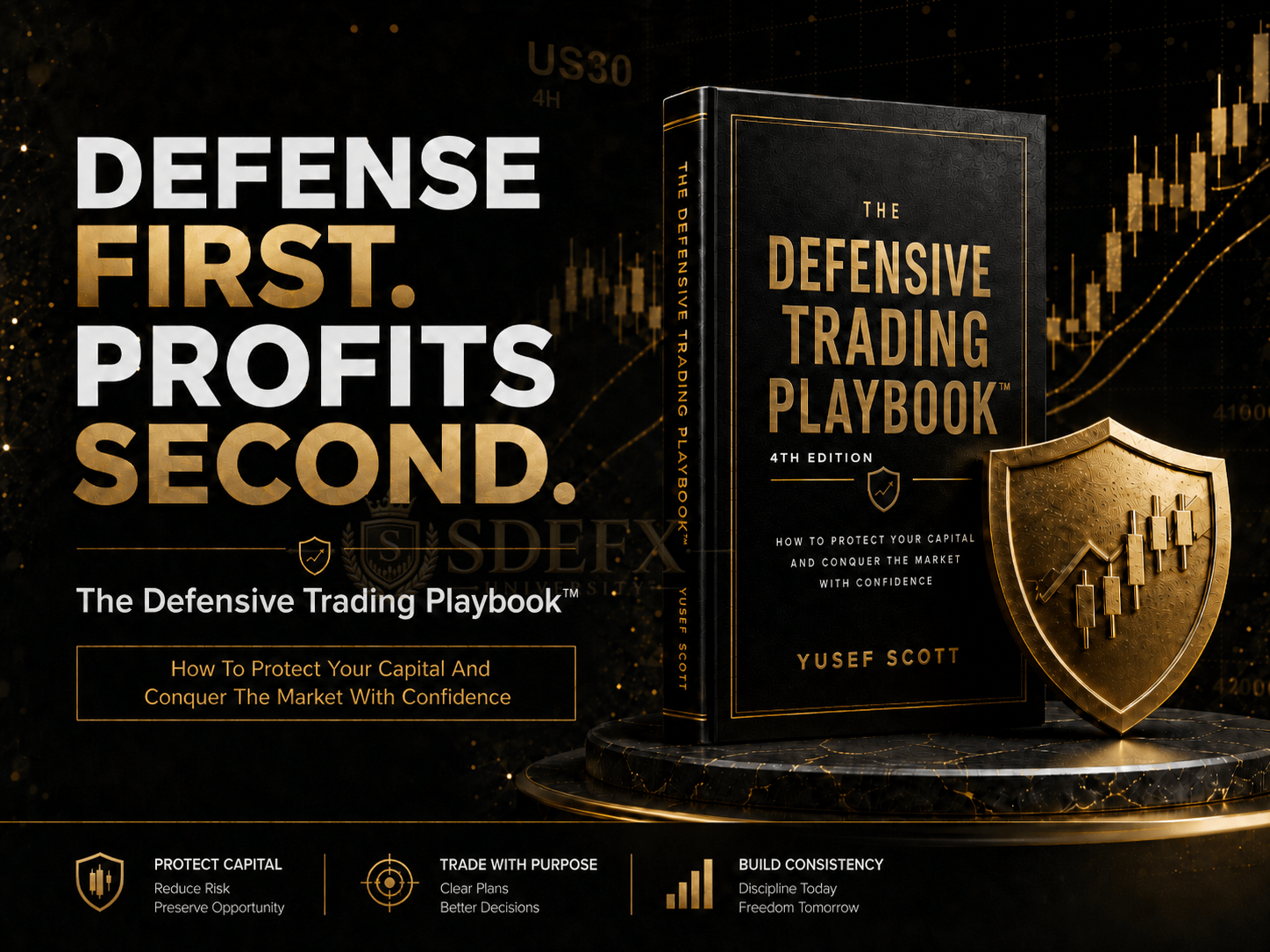
That principle is central to the Defensive Trading Playbook™.
The book explores the idea that protecting the account is not one isolated action. It is the result of multiple decisions working together.
Those decisions include:
Market selection
Entry quality
Timing
Position sizing
Exposure
Patience
Emotional control
Direct observation
Trade management
Knowing when not to trade
A stop-loss order is one possible defensive tool.
It is not the complete defensive system.
What Some of My Students Have Noticed
Many students come to SDEFX University™ after years of being repeatedly stopped out.
They often describe a familiar pattern:
They identify the market direction.
They enter the trade.
The market moves briefly against them.
Their stop loss closes the position.
Price then travels toward the original target without them.
Over time, that cycle can create fear.
The trader begins expecting every entry to fail.
Some students start placing wider stops without understanding the additional financial risk. Others reduce their stops so dramatically that normal price movement closes nearly every trade.
Still others avoid otherwise valid setups because they no longer trust their own analysis.
Students who learn my approach often report that they begin viewing the market differently.
They become more selective.
They focus more heavily on entry quality.
They pay closer attention to support, resistance, volatility, and price behavior.
They stop trading markets they cannot directly watch.
They also begin distinguishing between temporary adverse movement and true invalidation of the underlying trade idea.
Some students have reported improved personal success after reducing their dependence on conventional stop losses. That is anecdotal student experience, not a guaranteed result, and it should not be interpreted as proof that every trader will perform better without stops.
My position is not that everybody should trade this way.
My position is that the traditional approach is not the only possible approach.
The Risks of Trading Without a Stop Loss
An honest educator must explain the risk on both sides.
Trading without a conventional stop-loss order can expose the trader to substantial danger.
Potential risks include:
Sudden price spikes
News shocks
Unexpected volatility
Platform failure
Internet failure
Broker outages
Slippage
Liquidity disruptions
Emotional hesitation
Inability to close the position
Losses larger than anticipated
The possible loss of the entire account
A trader who removes a stop also removes an automated emergency mechanism.
That places greater responsibility on the individual.
The trader must be present.
The trader must manage exposure conservatively.
The trader must understand the market being traded.
The trader must possess a disciplined exit process.
The trader must be willing to act when the analysis is invalidated.
This is why I do not present my approach as appropriate for every trader.
Anyone who cannot watch a position, control risk, manage emotions, or follow a developed process should not treat this article as permission to trade without a stop loss.
FINRA and the SEC both emphasize that stop orders are used as market-risk tools, particularly for investors who do not intend to monitor prices continuously.
My method depends on the opposite condition:
I am actively monitoring the trade.
This Is Not an Anti–Stop Loss Argument
My philosophy is not built around opposing every conventional practice.
I can see the potential value of a stop loss in several situations.
For example:
The trader cannot monitor the position.
The trader is holding overnight.
The strategy requires automated exits.
A proprietary or funded account requires stops.
The instrument carries substantial gap risk.
The trader has not developed the discipline needed for active management.
The trader’s platform or broker rules require predefined risk.
It is simply not my preferred tool for the trades I directly observe and manage.
My rule is:
Do not trade what you cannot watch.
That single principle changes the nature of the decision.
My approach is not:
“Enter without a stop and hope.”
My approach is:
Trade selectively, remain present, control your exposure, manage defensively, and follow the rules.
I Am Unorthodox by Nature
Many accepted trading practices are passed down as universal truths:
Always use this indicator.
Always trade this timeframe.
Always risk this percentage.
Always place your stop behind this candle.
Always enter when these two lines cross.
Always accept the methods traditionally taught.
I do not accept a practice simply because it is popular.
I test it.
I study its weaknesses.
I observe how it behaves in the market.
I ask whether it helps traders develop—or simply makes them feel temporarily protected.
The financial markets have evolved.
Technology has changed.
Execution has changed.
Liquidity has changed.
Retail participation has changed.
The instruments many people trade have changed.
The US30, NAS100, and S&P 500 can move with extraordinary speed. A trader operating in these markets must understand volatility, levels, timing, market sessions, and exposure.
I refuse to build my entire approach around practices borrowed from prior generations without examining whether they still make sense within the way I trade today.
That is why I created the Trading Framework™.
The Trading Framework™ does not treat trading as one strategy or one order type.
It brings multiple components together:
The Defensive Trading Playbook™
Money management
Mental and psychological discipline
Entry logic
Support and resistance
Market structure
Trade management
Independent thinking
Accountability
Signals With Guidance™
Everything has a purpose.
Everything is connected.
No Stop Loss Does Not Mean No Defense
This is the most important distinction in the entire article:
No stop loss does not mean no defense.
A trader operating without a conventional stop still needs:
A logical reason for entering
A clearly defined trade thesis
Controlled position size
A method for recognizing invalidation
The ability to monitor price
A disciplined exit process
A maximum acceptable level of exposure
Emotional control
The willingness to act when conditions change
Without those things, a trader is not using an advanced method.
The trader is gambling.
My approach requires more responsibility—not less.
Because I am not delegating the complete defensive decision to an automated order, I must remain more engaged.
I must choose better entries.
I must be more selective.
I must monitor the market.
I must control volume.
I must understand why I entered.
And I must know what I am going to do before the situation becomes emotional.
That philosophy is at the heart of the Defensive Trading Playbook™.
The Purpose of SDEFX University™
Today, I operate SDEFX University™, where the objective is not simply to show traders how to press buy or sell.
We develop traders.
Many of our students arrive after years of losses, repeated stop-outs, signal chasing, inconsistent execution, and disconnected trading education.
They do not always need another strategy.
They need a framework.
Through the Trading Framework™, Signals With Guidance™, and our Legacy Memberships, students begin learning how the pieces of the market work together.
Our primary market focus includes:
US30
S&P 500
NAS100
These markets can create significant opportunity, but they also require discipline and respect.
The signal may identify the opportunity.
The guidance helps the trader understand what is happening while the market develops.
The goal is not permanent dependence.
The goal is for students to become capable of thinking through the market independently.
Final Thoughts
I understand why stop losses are widely recommended.
I understand why they are useful for many traders.
I understand why regulators and brokers describe them as risk-management tools.
But I have also seen traders correctly identify the market’s eventual direction and still lose because their stop was triggered during a temporary price movement.
Research confirms that stop orders can cluster at visible levels, contribute to rapid price cascades, and execute differently from the selected trigger price during volatility. Documented investigations have also examined improper efforts to trigger client stop-loss orders.
That does not prove every stop was deliberately hunted.
It does demonstrate that stop-loss behavior is more complex than many beginning traders are taught.
My conclusion is personal:
A conventional stop loss is not the right tool for the way I actively trade.
I only trade what I can watch.
I manage from a defense-first perspective.
I control my exposure.
I follow a process developed through years of market experience.
And I teach students that defense begins long before they enter a trade.
This is not an invitation to remove your stop loss tomorrow.
It is an invitation to think more deeply about what actually protects you.
Because the goal is not to blindly follow tradition.
The goal is to become a disciplined trader who understands why every decision is being made.
At SDEFX University™, we do not simply teach people what to trade.
We develop traders.
Risk Disclosure
Micah practiced the referenced opportunity on a demo account. The 1,100-plus points discussed in this article refer to total signal opportunities identified across multiple markets and do not represent points personally captured by Micah or guaranteed financial results.
Trading Forex, indices, contracts for difference, futures, and other leveraged financial products involves substantial risk and is not suitable for every individual. Educational content, market commentary, Signals With Guidance™, and student testimonials do not guarantee profits, account growth, winning trades, or future performance. Individual results will vary.
About The Author

Yusef Scott
Yusef Scott is the founder of SDEFX University™ and creator of the Trading Framework™, Signals With Guidance™, and the Defensive Trading Playbook™. With more than two decades of financial-market experience and over 15 years mentoring traders, he specializes in helping serious traders approach US30, Forex, and global markets with greater structure, discipline, risk awareness, and confidence.
Take Your Education Beyond the Blog
Join the 1 Trade Away Mastermind™ and discover how the Trading Framework™ helps serious traders approach US30 with greater structure, patience, discipline, and confidence.

We offer structured trading education built to help traders think with discipline, trade with clarity, and approach the market through the Trading Framework™.



**Disclaimer: Trading financial markets involves substantial risk and is not suitable for every investor. The content, training, Signals With Guidance™, Trading Framework™, trade setups, market analysis, and educational materials provided by So Darn Easy Forex University® are intended for educational and informational purposes only and should not be construed as financial, investment, tax, or legal advice.
Past performance is not indicative of future results. Any examples of profits, point gains, account growth, or student testimonials are exceptional results and are not guarantees of future performance. Individual results will vary based on experience, market conditions, risk management, discipline, capital, and adherence to the Trading Framework™.
All trading decisions are made solely at your own risk. You are responsible for evaluating the suitability of any trade and for managing your own account. Never trade with money you cannot afford to lose.
The applicable Point Guarantee™ relates solely to the number of qualifying setup opportunities provided through Signals With Guidance™ during the applicable guarantee period and does not guarantee profits, account growth, or successful trade execution. Please refer to the official Guarantee Terms & Conditions for complete details.
By using this website, purchasing our products or services, or participating in our community, you acknowledge that you understand the risks associated with trading and agree that So Darn Easy Forex University®, Yusef Scott, and their affiliates shall not be liable for any trading losses or damages resulting from the use of our educational content or services.
© The SDEFX University | A GIS Company 2026. All rights reserved.